Monday, 24 November 2014

sensory war 1914-2014

 
Steven Kasher Gallery is proud to present an exhibition of  Timothy Greenfield-Sanders portraits of wounded  veterans of the war in Iraq.  Greenfield-Sanders was commissioned by HBO to photograph soldiers whose injuries include devastating brain damage, triple amputation and blindness.  The pictures were made to accompany the HBO documentary special Alive Day Memories: Home From Iraq
There’s Dawn Halfaker, a West Point graduate, holding the prosthesis for her missing right arm like a part of herself that’s become temporarily disconnected. There’s Mike Jernigan, one eye socket empty, the other with a plastic eye studded with diamonds from the wedding ring his wife returned to him when they divorced after his return from Iraq. There’s John Jones, all business in his Marine uniform above the waist, two robotic legs naked
Greenfield-Sanders says: “I think we need to see this. We don’t see the dead coming back in coffins. We’re sheltered from the injured. We just don’t see it. It’s all been brilliantly hidden from view. So this documentary is very important in letting us see these people, let us know who they are, and make us ask if this war is worth it."

Thursday, 20 November 2014

Ken Unsworth

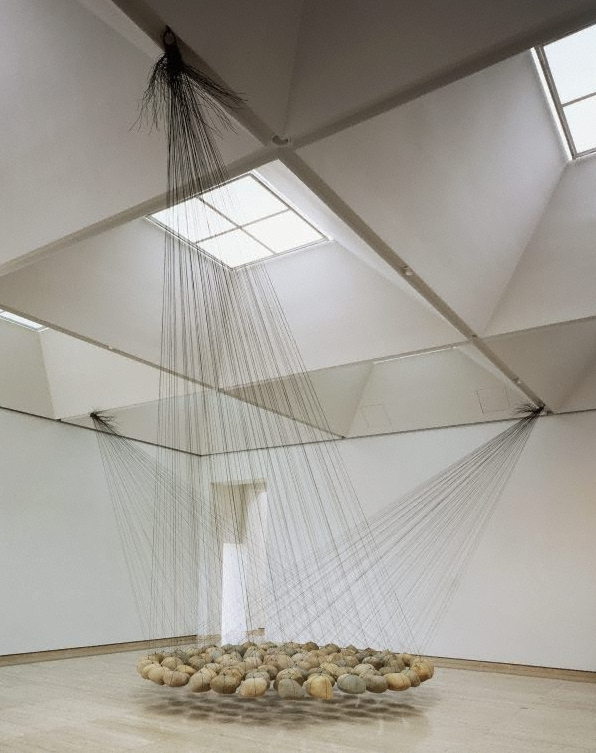
For many years, Australian-based artist Ken Unsworth has made viewers hold their breath with his timeless work entitledSuspended Stone Circle II. The installation was first completed in 1974 and produced again in 1988, and is awe-inspiring in both its fragility and volume. Unsworth used 103 river stones each weighing about 33 pounds and bound them together by three sets of wires that were tied to rings and secured to the ceiling. They form a suspended disc, with each element resting perfectly in its place. The sculptor hung the stones so that their center of gravity falls on the central axis of the disc, and each stone is equal distance from one another. As they remain in midair, their cone-shaped stabilizing wires mimic a force field, and it’s almost as if they are held up by this energy. Unsworth’s installation is peaceful, balanced, and even a little nerve wracking – at any moment, the work could theoretically come tumbling down. Unsworth first gained popularity as a sculptor in the 1970’s when he combined performance art with minimalist forms. In addition to stones, the artist has created other monumental works, including a piece titled Rapture, where a grand piano is formed into a large set of stairs.

openhouse-magazine-hanging-around-art-suspended-stone-circle-ii-by-ken-unsworth-australia 1


Wednesday, 5 November 2014

Work Experience

Sorry its a bit late but here are some of the things that were part of my experience with high school and college art students... a few little tie dye testers, exhibition work, exam pieces etc...


Banksy at Manchester art Gallery...


London


Anya Gallaccio at the V&A

Anya Gallaccio (born 1963) is a British artist, who often works with organic matter.
The year she graduated from Goldsmiths—she exhibited in the Damien Hirst-curated Freeze exhibition, and in 1990 the Henry Bond and Sarah Lucas organised East Country Yard shows, which brought together many of the Young British Artists. Gallaccio is a Professor in the Department of Visual Arts at the University of California, San Diego (UCSD).

When I went to London me and my friend organised to go on a little tour 'behind the scenes' of the V&A in order to see some of the work that hadn't been on show yet... so we found an Anya Gallaccio piece as well as an Antony Gormley inspired piece...


John Constable at the V&A


Tony Cragg: Raleigh


I went to Liverpool to the Albert Docks to view one of Craggs public sculptures called 'Raleigh'. The title 'Raleigh' relates to the sixteenth-century navigator Sir Walter Raleigh  who was a famous sailor for the Queen. Within the piece it consists of 6 individual elements: two iron bollards, two granite bollards and two horn shapes that were originally made from cast iron. These six elements were assembled on the site and arranged by a crane with careful instructions by Cragg. The sculpture was originally constructed in Liverpool in 1986 as part of a series of organised summer events by the Tate Gallery Liverpool and the Merseyside Development Corporation along with the Walker Gallery. One of the reasons it was there, was to draw attention to the development of the Tate two years prior to its opening.
The sculpture was not aimed to be site-specific, it is now permanently there.  After it was displayed in Liverpool, it had been moved to be reassembled at the Hayward Gallery, London in March 1987 for Cragg's Arts Council exhibition. Due to the fact the Tate wanted it back to promote their development, ‘Raleigh’ was returned to the original site in Liverpool in June 1987. As Cragg's customary practice was to assemble his sculptures around the idea of unwanted objects, he also used special fabricated objects. He drew a foundation of the sculpture in chalk on the floor so the workers could essentially recreate that into the main sculpture.
Cragg has always been a sculptor who normally considered his work as utilitarian- something that was designed to be practical rather than having aesthetic value. His idea behind 'Raleigh' is to pose a gesture or greeting to whoever has left Liverpool or to say welcome to the people who are initially arriving to the city. The two horn shapes that point out in different directions simply imply the fanfare or a farewell to those who are leaving Liverpool. It is symbolic to how foghorns are used to spread messages across the sea to sailors. Cragg feels that his sculpture shows how he can bring his optimism about his birthplace and welcome the renewal of Liverpool.
According to Cragg, his 1981 piece called 'Horns' had partly lead on the creations of 'Raleigh'. 'Horns' was made of man-made objects in both natural and synthetic materials which were later distributed on the ground in the shape of a horn.

Sheffield gallery


Tuesday, 4 November 2014

John Ruskin

I recently went to a small local gallery when I was on a trip to one of Sheffields universities and came across a few John Ruskin pieces...

A brief outline of John Ruskin
He was a leading English art critic of the Victorian era, also an art patron, draughtsman, watercolourist, a prominent social thinker and philanthropist. He wrote on subjects ranging from geology to architecture, myth to ornithology, literature to education, and botany to political economy. In 1869, Ruskin became the first Slade Professor of Fine Art at the University of Oxford, where he established the Ruskin School of Drawing.

 
Actual pictures coming soon...