Monday, 24 November 2014

sensory war 1914-2014

 
Steven Kasher Gallery is proud to present an exhibition of  Timothy Greenfield-Sanders portraits of wounded  veterans of the war in Iraq.  Greenfield-Sanders was commissioned by HBO to photograph soldiers whose injuries include devastating brain damage, triple amputation and blindness.  The pictures were made to accompany the HBO documentary special Alive Day Memories: Home From Iraq
There’s Dawn Halfaker, a West Point graduate, holding the prosthesis for her missing right arm like a part of herself that’s become temporarily disconnected. There’s Mike Jernigan, one eye socket empty, the other with a plastic eye studded with diamonds from the wedding ring his wife returned to him when they divorced after his return from Iraq. There’s John Jones, all business in his Marine uniform above the waist, two robotic legs naked
Greenfield-Sanders says: “I think we need to see this. We don’t see the dead coming back in coffins. We’re sheltered from the injured. We just don’t see it. It’s all been brilliantly hidden from view. So this documentary is very important in letting us see these people, let us know who they are, and make us ask if this war is worth it."

Thursday, 20 November 2014

Ken Unsworth

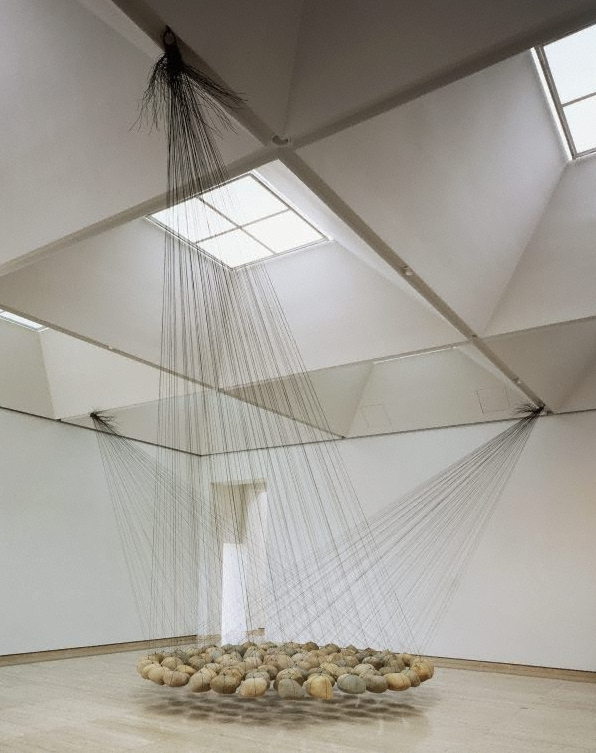
For many years, Australian-based artist Ken Unsworth has made viewers hold their breath with his timeless work entitledSuspended Stone Circle II. The installation was first completed in 1974 and produced again in 1988, and is awe-inspiring in both its fragility and volume. Unsworth used 103 river stones each weighing about 33 pounds and bound them together by three sets of wires that were tied to rings and secured to the ceiling. They form a suspended disc, with each element resting perfectly in its place. The sculptor hung the stones so that their center of gravity falls on the central axis of the disc, and each stone is equal distance from one another. As they remain in midair, their cone-shaped stabilizing wires mimic a force field, and it’s almost as if they are held up by this energy. Unsworth’s installation is peaceful, balanced, and even a little nerve wracking – at any moment, the work could theoretically come tumbling down. Unsworth first gained popularity as a sculptor in the 1970’s when he combined performance art with minimalist forms. In addition to stones, the artist has created other monumental works, including a piece titled Rapture, where a grand piano is formed into a large set of stairs.

openhouse-magazine-hanging-around-art-suspended-stone-circle-ii-by-ken-unsworth-australia 1


Wednesday, 5 November 2014

Work Experience

Sorry its a bit late but here are some of the things that were part of my experience with high school and college art students... a few little tie dye testers, exhibition work, exam pieces etc...


Banksy at Manchester art Gallery...


London


Anya Gallaccio at the V&A

Anya Gallaccio (born 1963) is a British artist, who often works with organic matter.
The year she graduated from Goldsmiths—she exhibited in the Damien Hirst-curated Freeze exhibition, and in 1990 the Henry Bond and Sarah Lucas organised East Country Yard shows, which brought together many of the Young British Artists. Gallaccio is a Professor in the Department of Visual Arts at the University of California, San Diego (UCSD).

When I went to London me and my friend organised to go on a little tour 'behind the scenes' of the V&A in order to see some of the work that hadn't been on show yet... so we found an Anya Gallaccio piece as well as an Antony Gormley inspired piece...


John Constable at the V&A


Tony Cragg: Raleigh


I went to Liverpool to the Albert Docks to view one of Craggs public sculptures called 'Raleigh'. The title 'Raleigh' relates to the sixteenth-century navigator Sir Walter Raleigh  who was a famous sailor for the Queen. Within the piece it consists of 6 individual elements: two iron bollards, two granite bollards and two horn shapes that were originally made from cast iron. These six elements were assembled on the site and arranged by a crane with careful instructions by Cragg. The sculpture was originally constructed in Liverpool in 1986 as part of a series of organised summer events by the Tate Gallery Liverpool and the Merseyside Development Corporation along with the Walker Gallery. One of the reasons it was there, was to draw attention to the development of the Tate two years prior to its opening.
The sculpture was not aimed to be site-specific, it is now permanently there.  After it was displayed in Liverpool, it had been moved to be reassembled at the Hayward Gallery, London in March 1987 for Cragg's Arts Council exhibition. Due to the fact the Tate wanted it back to promote their development, ‘Raleigh’ was returned to the original site in Liverpool in June 1987. As Cragg's customary practice was to assemble his sculptures around the idea of unwanted objects, he also used special fabricated objects. He drew a foundation of the sculpture in chalk on the floor so the workers could essentially recreate that into the main sculpture.
Cragg has always been a sculptor who normally considered his work as utilitarian- something that was designed to be practical rather than having aesthetic value. His idea behind 'Raleigh' is to pose a gesture or greeting to whoever has left Liverpool or to say welcome to the people who are initially arriving to the city. The two horn shapes that point out in different directions simply imply the fanfare or a farewell to those who are leaving Liverpool. It is symbolic to how foghorns are used to spread messages across the sea to sailors. Cragg feels that his sculpture shows how he can bring his optimism about his birthplace and welcome the renewal of Liverpool.
According to Cragg, his 1981 piece called 'Horns' had partly lead on the creations of 'Raleigh'. 'Horns' was made of man-made objects in both natural and synthetic materials which were later distributed on the ground in the shape of a horn.

Sheffield gallery


Tuesday, 4 November 2014

John Ruskin

I recently went to a small local gallery when I was on a trip to one of Sheffields universities and came across a few John Ruskin pieces...

A brief outline of John Ruskin
He was a leading English art critic of the Victorian era, also an art patron, draughtsman, watercolourist, a prominent social thinker and philanthropist. He wrote on subjects ranging from geology to architecture, myth to ornithology, literature to education, and botany to political economy. In 1869, Ruskin became the first Slade Professor of Fine Art at the University of Oxford, where he established the Ruskin School of Drawing.

 
Actual pictures coming soon...

Wednesday, 29 October 2014

Invisible art?

An article of Lana Newstorm

“Art is about imagination and that is what my work demands of the people interacting with it. You have to imagine a painting or sculpture is in front of you”.

The invisible art of Lana Newstrom is in fact a hoax, perpetrated by professional radio parodists Pat Kelly and Peter Oldring. But I can see why so many people fell for it – especially having just covered the Turner prize.
While all of the work in this year’s Turner is just about visible, this prize has often featured the not-quite-there. Martin Creed and Susan Philipszboth won it for empty rooms – Creed’s with the lights going on and off, Philipsz’s with a folk song sound installation. And that’s just the tip of an invisible iceberg.
For Lana Newstrom is not the radical artist she has been taken for. Her work is old hat. I am yawning, it is so retrograde and familiar – just another rehash of ideas that go back to the 1950s. Ever hear of John Cage? The Hayward Gallery even dedicated a historical exhibition in 2012 to this phenomenon. Invisible: Art about the Unseen, 1957-2012 “is not a joke”, insisted curator Ralph Rugoff. And it wasn’t.
This year, Marina Abramović caused a stir when she said her exhibition at London’s Serpentine would be about “nothing”. Yet the controversy was not about the potential invisibility of the idea – it was about plagiarism, for another artist CLAIMED prior rights in nothing.
So, given that if anything Lana Newstrom’s art is a bit staid and behind the times, it is not so strange that people were fooled by the hoax. On the other hand, what they took from it is revealing. It shows how much we hate the rich.
A website called Wealthy Debates relished the exposure, not so much of art, as of art collectors. Believing Lana Newstrom to be real, it sneered at her stupid rich collectors. “The most amusing aspect of the story,” it enthused, “is the image of snobby art collectors walking through an empty studio studiously staring at blank walls ... Some of the art afficianados [sic] actually stop and soak in the lack of art that is not hanging on the blank wall...”
Barstool Sports agreed: “If you’re some artsy fartsy idiot paying money for invisible art, you GOTTA kill yourself. Imagine paying someone a million dollars for some Emperor’s New Clothes shit?...”
The reason CBC’s joke story had legs is not so much that we want to laugh at contemporary art, as that we are so shocked and repelled by the art MARKET. The image of rich people forking out for invisible art and proudly showing it to their friends as the very latest thing is such a glorious image of plutocratic idiocy that it just had to be true.
If only it were. I want to see those rich art snobs suffer, too. But not only is this story a hoax – it also appears to be untrue that collectors will pay a fortune for the non-existent. For when Christie’s tried to auction Creed’s Work No 127: The Lights Going On and Off for £70,000 earlier this year it did not sell.
So here’s the punchline. Invisible art really does exist. And it’s going cheap.
Invisible art Lana Newstrom CBC hoax

Antony Gormley


I recently went to London and came across an Antony Gormley (first picture). The second one is of an exhibition in Manchester where his work was hanging from the ceiling over the stairs.
Gormley describes his work as "an attempt to mater
ialise the place at the other side of appearance where we all live." Many of his works are based on moulds taken from his own body, or "the closest experience of matter that I will ever have and the only part of the material world that I live inside."
His work attempts to treat the body not as an object but a place. The work is not symbolic but a trace of a real event of a real body in time.
Gormley won the Turner Prize in 1994 with Field for the British Isles. He was quoted as saying that he was "embarrassed and guilty to have won – it's like being a Holocaust survivor. In the moment of winning there is a sense the others have been diminished. I know artists who've been seriously knocked off their perches through disappointment."


Tuesday, 21 October 2014

Banksy

I had recently found a Banksy piece that I was really intrigued by... my first impressions were 'wow what a shocking image' I understood it straight away! It is a college stencil piece incorporating the Napalm war- the horrible attack of the American troops on Vietnam
Within the picture it interprets so much power but at the same time I just feel so helpless. When I first saw this piece of art I was shocked. The way in which the child is black and white and the characters have contrasting colours (such as black and yellow) indicates that the child is being pulled along by the major superpower of the USA! It also tries to point out, in an cleverly ironic way, how the Americans are treating the Vietnamese people. It shows how they are being manipulated by the USA- hence the fact the two characters are holding up the child's arm. It is a display of dominance. As a geography student I can see the widening gap between economic development which is clearly shown  through this picture- the globalisation of goods and services, cheap labour etc...
The characters captured my attention the most I think... I think they actually look at bit sinister with their patronising smiles! Maybe that's the effect?
The question I ask myself is... Where are they going?


Wednesday, 15 October 2014

Jackson Pollock

I had recently visited The Liverpool Tate and came across a Jackson Pollock piece.
A friend of mine who came with me said; "I could do that... that's not art" (in reference to seeing a Jackson Pollock)... ONE OF MY PET HATES!!!!!
Though I have never been fully keen or widely knowledgeable on him but as I looked into him more I began to understand the real context behind his work...

He started using synthetic resin-based paints called alkyd enamels, which, at that time, was a novel medium. Pollock described this use of household paints, instead of artist’s paints, as "a natural growth out of a need". He used hardened brushes, sticks, and even basting syringes as paint applicators. Pollock's technique of pouring and dripping paint is thought to be one of the origins of the term action painting. With this technique, Pollock was able to achieve a more immediate means of creating art, the paint now literally flowing from his chosen tool onto the canvas. By defying the convention of painting on an upright surface, he added a new dimension by being able to view and apply paint to his canvases from all directions.

Later, a series of influences came together to guide Pollock to his mature style: years spent painting realist murals in the 1930s showed him the power of painting on a large scale; Surrealism suggested ways to describe the unconscious; and Cubism guided his understanding of picture space.
Also, he used this 'drip' technique to express his feelings as he was an alcoholic and it shows his expressions as the stand for the terror of all modern humanity living in the shadow of nuclear war.


Wednesday, 8 October 2014

From the words of Tony Cragg himself...

"When you’re born, you’re born with a fantastic organ in your head.  There’s not much in it. And you open your eyes and you start to hear and you feel temperature and smell things and hear things and want to touch things — through your senses. Your senses, you have to see as being your inside body communicating with the outside. So it is collecting all this data about the world. Where you’ve got data you’ve got a syntax. So this, if you like, is some kind of language. Your finding out what surfaces are, what softness is, what hardness is, what noises – everything. So through your senses, you filled up these fantastic senses of perceptions of the world, and you use them very shortly after that to survive. You know what tastes good; you know what noises you don’t like; you know what forms are interesting for you, and whatever. And this is a language. You can’t write it down, but that material is already talking to us. Material gives us a message, and we go out and we read into the material something."